

Wireless internet connectivity’s landscape is always changing. WiFi technology is improving at an unheard-of rate in response to an always rising need for faster speeds, more dependable connections, and improved coverage. From WiFi 6 to the forthcoming WiFi 7, these developments promise to transform our connection, work, and entertainment. The newest WiFi technologies will be discussed in this post together with how they are altering our internet usage and what to expect not too far future.
WiFi Technology: An Evolution
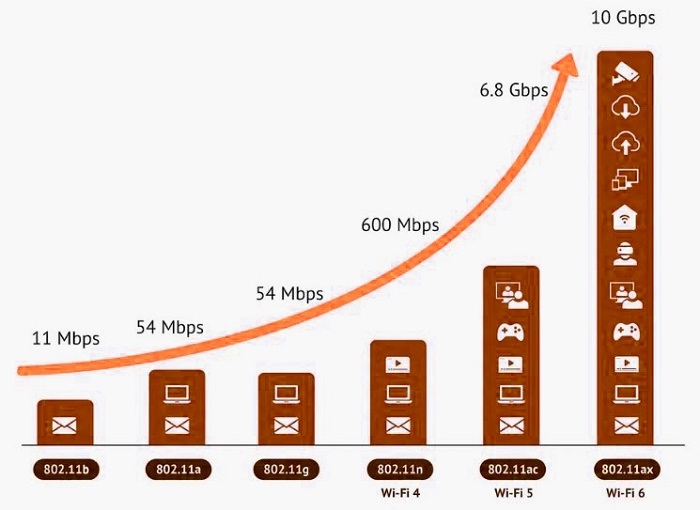
Since its introduction, WiFi technology has progressed a great distance. Launched in 1999, 802.11b was the initial WiFi standard and could run up to 11 Mbps. By now, the newest WiFi technologies boast rates of up to 9.6 Gbps. Speed, range, and efficiency have all improved with every fresh WiFi iteration. From WiFi 4 to WiFi 5, and now WiFi 6 and WiFi 7, the evolution of the technology is evident.
WiFi 6: The Revolutionary Player
The newest generally adopted standard that has greatly improved wireless networks is WiFi 6, sometimes known as 802.11ax. WiFi 6, which debuted in 2019, provides faster speeds, more consistent connections, and more efficiency—especially in packed areas like offices and stadiums.
WiFi 6’s capacity to manage many devices concurrently is one of its primary strengths. WiFi 6 divides the channel into smaller sub-channels utilizing Orthogonal Frequency Division Multiple Access (OFDMA), allowing more connected devices to send data at the same time without generating interference, given the rising count of linked devices in our homes and companies.
WiFi 6 also brings Target Wake Time (TWT), which lets devices save battery life. TWT reduces unneeded power usage by timing device waking and router communication.
WiFi 6E: Expanding the Horizon
Operating in the recently available 6 GHz frequency band, WiFi 6E is a variation on WiFi 6. WiFi devices used to be limited to the 2.4 GHz and 5 GHz frequencies, which can get packed in places with many wireless gadgets. Faster and more dependable connections can result from the 6 GHz band’s more channels and reduced congestion.
Applications include online gaming, virtual reality (VR), and 4K/8K streaming that call for reduced latency will find WiFi 6E a revolutionary tool. WiFi 6E offers enhanced performance in both rural locations with limited bandwidth and high-density environments by extending the accessible spectrum.
WiFi 7: The Frontier in Connectivity Still To Come
While WiFi 6 and WiFi 6E are still generating waves, WiFi 7 (802.11be) is already under development. With even faster speeds, more storage, and better efficiency, WiFi 7 looks to be a major leap forward.
WiFi 7 is supposed to run throughout the 2.4 GHz, 5 GHz, and 6 GHz ranges using up to 320 MHz of bandwidth per channel. Ideal for data-heavy uses like 8K streaming, augmented reality (AR), and ultra-high-density video conversations, this is double the bandwidth accessible in WiFi 6 and allows speeds of up to 46 Gbps.
Advanced technologies including Multi-Link Operation (MLO), which lets devices link to several frequency bands concurrently, will also be included into WiFi 7. Particularly in settings with many devices and strong interference, this function will help to offer lower latency and more steady connections.
Improved modulation is yet another fascinating aspect of WiFi 7. Comparatively to WiFi 6’s 1024-QAM, which will enable more data speed in high-demand situations, it will support 4096-QAM (Quadrature Amplitude Modulation).
Features of the New WiFi Technologies
WiFi technology’s ongoing developments offer several advantages for people as well as for companies. Following are some main benefits:
Accelerated Rates
Internet speeds are exponentially rising in line with the most recent WiFi standards. WiFi 6, WiFi 6E, and WiFi 7 offer speeds much above those of past versions. Faster downloads, greater performance in online gaming, and smoother video streaming made possible by these quicker speeds help to explain.
Enhanced Range and Coverage
Additionally providing better coverage are more recent WiFi technology. Particularly WiFi 6 and WiFi 6E are more adept in breaking through walls and covering greater distances, thereby ensuring a more consistent connection in several rooms of your house or workplace.
Improved Network Possibilities
Having a network that can manage several devices without slowing down becomes absolutely vital as more and more gadgets are linked to the internet. The newest WiFi technologies are meant to enable more devices concurrently without sacrificing performance.
Reduced Lagency
WiFi 6 and WiFi 7 claim to lower latency, therefore enabling real-time applications including virtual reality, gaming, and video conferences to be more responsive. Particularly in highly demand contexts, lower latency guarantees consumers’ experience to be better.
WiFi plus the Internet of Things (IoT)
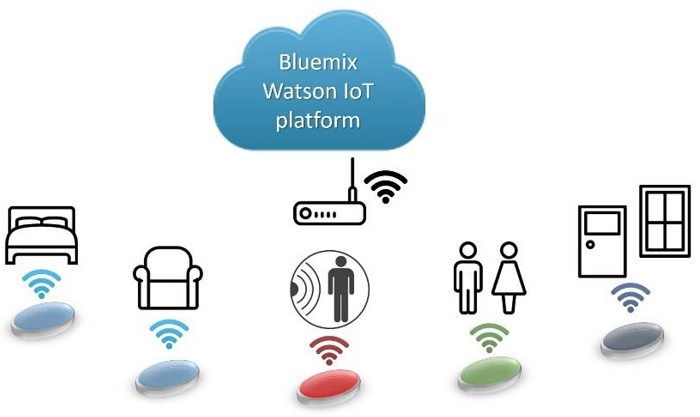
In the framework of the Internet of Things (IoT), the most recent WiFi technologies especially matter. Reliable, fast WiFi becomes increasingly more important as more devices—including smart home appliances, security cameras, and wearable sensors—connect to the internet. Designed to meet the higher demand from these devices, WiFi 6 and WiFi 7 offer faster speeds and more consistent connections even if numerous devices are running concurrently.
Improvements in Security Based on Latest WiFi Guidelines
Security now takes the stage as WiFi is used for everything from banking to business communications. Several significant security improvements are included into the most recent WiFi technology.
The newest WiFi security standard, WPA3, presented by WiFi 6 offers enhanced encryption and improved resistance against brute-force attacks. Particularly in public venues like cafés or airports, WPA3 makes it more difficult for hackers to access systems.
With even more strong security measures that guarantee your data stays safe when linked to wireless networks, WiFi 7 is expected to build on existing advancements.
How to Utilize the Newest WiFi Technologies
You’ll need compatible devices to fully benefit from the newest WiFi technology. Experience the advantages of WiFi 6 or WiFi 6E by means of routers supporting WiFi 6 or WiFi 6E-enabled smartphones, laptops, and other devices.
Routers and gadgets meant to enable the high speeds and low latency WiFi 7 promises will be a new generation of products for the next WiFi.
Improving Your Household Network
Upgrading your home network is crucial if you wish to take advantage of the newest WiFi technologies. Purchasing a WiFi 6 or WiFi 6E router will enable you to make best use of your present equipment. Changing your gadgets to ones that enable WiFi 6 or WiFi 6E will also clearly increase performance.
Frequently Asked Questions
Describe WiFi 6 and explain how it works.
The most recent WiFi standard providing faster speeds, more capacity, and more efficiency is WiFi 6. It makes more devices able to connect concurrently free from interference.
How differs WiFi 6 from WiFi 6E?
Operating in the 6 GHz frequency band, WiFi 6E is an expansion of WiFi 6 that provides more channels and reduced congestion for quicker and more consistent connections.
WiFi 7 offers what advantages?
WiFi 7 is perfect for data-heavy uses such virtual reality and 8K streaming since it promises faster speeds, improved efficiency, and lower latency.
Can older devices run WiFi 7?
Older WiFi devices will be compatible with WiFi 7, however to fully enjoy the advantages you will require WiFi 7-enabled devices.
How may I upgrade to WiFi 6E or WiFi 6?
You’ll need WiFi 6 or WiFi 6E routers and devices supporting the new standard to update. WiFi 6 compatible versions of many modern smartphones, laptops, and smart home appliances abound.
