
Mobile networks are becoming absolutely necessary for data flow and communication in the fast-paced digital environment of today. 3G and LTE, or Long-Term Evolution, are two of the most often used mobile network varieties. Although both offer internet access, speed, performance, and technology are greatly different. Choosing a mobile network or updating your mobile device depends on an awareness of these variations. This page looks at the main differences between LTE and 3G so you may decide with knowledge.
What is 3G?
3G, or Third Generation, is the third iteration of mobile network technology, designed to provide faster internet speeds and better mobile communication than its predecessors. Originally introduced in the early 2000s, 3G made major changes in mobile data by enabling multimedia messages, video calls, and mobile internet surfing.
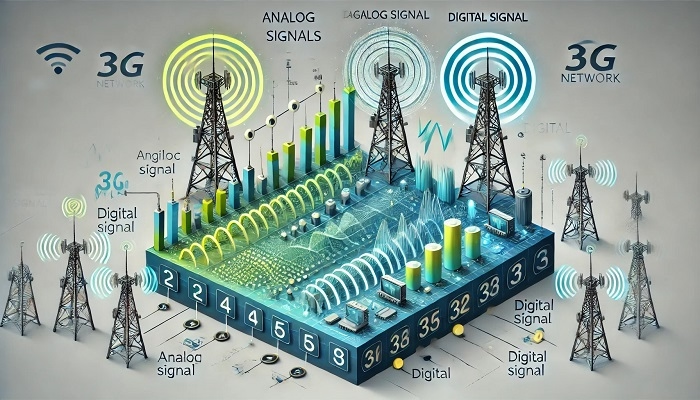
3G networks utilize a combination of WCDMA (Wideband Code Division Multiple Access), CDMA2000, and TD-SCDMA. Although 3G networks were revolutionary at the time, they are currently being replaced by more recent technologies, including 4G and LTE.
What is LTE?
Offering major speed and efficiency gains over 3G, LTE, or Long-Term Evolution, is the next generation of mobile network technology. Originally unveiled in the late 2000s, LTE has since evolved into the accepted norm for mobile data transfer in much of the globe.
LTE delivers faster speeds and more dependable connections using a more advanced architecture and several technologies like OFDMA (Orthogonal Frequency-Division Multiple Access) and MIMO (Multiple Input, Multiple Output) than 3G, which depends on older technology.
Key Variations Between LTE and 3G
Speed and Performance
Among the most obvious variations between LTE and 3G is their speed. Offering download rates of up to 100 Mbps (megabits per second) and upload speeds of up to 50 Mbps in optimal situations, LTE is far faster than 3G. By contrast, 3G usually provides upload speeds of about 1 Mbps and download speeds ranging from 384 Kbps to 2 Mbps.
Faster downloads, perfect video streaming, and better gaming experiences are made possible by LTE’s higher speeds. Conversely, 3G networks are slower and could find it difficult to handle highly sought-after programs such as HD video streaming or massive file downloads.
Latency
Latency in data refers to the travel times from the source to the destination. Lower latency is absolutely essential in mobile networks for real-time uses such as VoIP (Voice over Internet Protocol), online gaming, and video conferences.
With latency as low as 30–50 milliseconds, LTE networks have far less latency than 3G. For real-time applications, LTE is therefore perfect; 3G networks may have more delay, usually ranging from 100 to 200 milliseconds.
Coverage and Availability
Although both LTE and 3G networks are rather accessible, 3G networks serve more remote and rural areas—especially in nations where LTE development is still under progress. This is because 3G technology has been around for a longer length of time, allowing it to reach more areas.
LTE is fast spreading over the world, though, and many service providers are giving 4G LTE coverage top priority over 3G. Because of its faster speed and performance, LTE is thus usually the recommended network technology in urban areas and developed countries.
Network Capacity and Performance
More users and more data-intensive applications are expected of LTE networks than 3G ones in design. Technologies like OFDMA and MIMO let LTE support more concurrent connections without compromising speed or quality.
Though effective for their time, 3G networks were not built to manage the enormous data consumption observed now. Particularly in crowded regions, the general speed and performance can deteriorate as more people link to 3G networks.
Use of Power
Power consumption is another important variation between LTE and 3G. Particularly when mobile devices are actively using high-bandwidth applications like video streaming, LTE networks—despite their speed and efficiency—tend to consume more power than 3G.
But developments in LTE technology, including carrier aggregation and LTE-Advanced, have improved power efficiency, reducing the rising power consumption connected with fast data transfer.
The Benefits of LTE
- Faster Speeds: LTE is best for streaming, gaming, and heavy internet use since it provides quicker download and upload rates over 3G.
- Lower Latency: Reduced latency in LTE networks guarantees a better experience for real-time uses including gaming and phone calls.
- Better Network Efficiency: LTE can manage more users and data-intensive apps, therefore lowering the possibilities of congestion in highly crowded locations.
- Future-Proofing: LTE is replacing 3G networks as the norm for mobile networks, guaranteeing better long-term performance and compatibility as they phase off.
When is 3G Still Relevant?
Although LTE is now the preferred network for mobile data, 3G is still valuable in some circumstances. These include:
- Wider Coverage in Rural Areas: 3G remains a consistent choice for mobile access even in places without LTE coverage.
- Battery Life: For consumers worried about battery life, 3G can be more power-efficient for simple chores such as calling, texting, and surfing.
- Older Devices: Basic internet and communication services allow older cellphones and non-LTE capable mobile devices to continue connecting to 3G networks.
3G or LTE: Which is Better?
Your needs will determine which of LTE and 3G you should use. LTE is the best option if you need quicker speeds for streaming, gaming, or running data-intensive apps. 3G may be your only choice, though, if you live in a location with low LTE coverage or if your older gadget does not support 4G.
Thanks to its speed, reduced latency, and improved network efficiency, LTE is the better option for most consumers. However, in places where 4G networks are not present, 3G will still serve as a backup.
FAQs
Is LTE better than 3G?
Indeed, compared to 3G, LTE enables more data-intensive apps, is faster, and has reduced latency. In places with weak LTE service, 3G is still valuable, nonetheless.
Can I use 3G if my device supports LTE?
Yes, devices supporting LTE are also compatible with 3G networks. They will automatically switch to 3G in case LTE is not available.
Does LTE drain more battery than 3G?
Yes, especially with high-bandwidth uses like video streaming, LTE often consumes more power than 3G.
Why are LTE speeds higher than those of 3G?
Advanced technologies like OFDMA and MIMO enable LTE to deliver higher speeds and manage more simultaneous connections than 3G.
Will 3G networks vanish?
Yes, some nations and mobile companies are progressively switching 3G networks for LTE and more modern technologies like 5G.
