
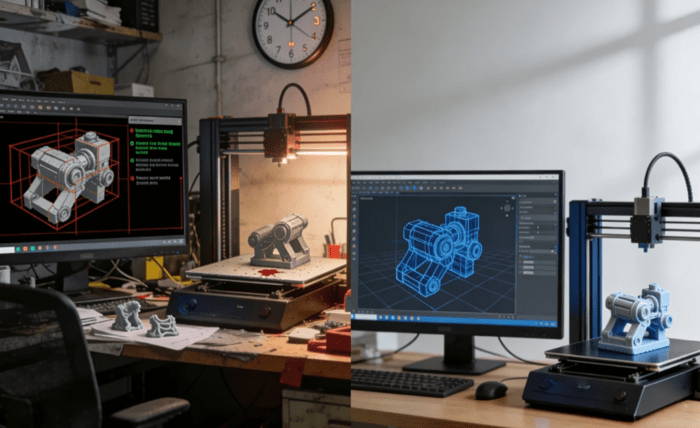
Most AI 3D generators compete on one thing: speed. Generate a model in five seconds. In three seconds. In the time it takes to blink. The marketing is everywhere. And the results are everywhere too. Models that look fine from one angle. Models that fall apart the moment you try to use them.
Speed is easy when you cut corners. Quality is hard. And for anyone who needs a 3D model for actual production, quality is the only thing that matters.
This comparison looks at three tools. Meshy and Tripo are the speed leaders. Neural4D takes a different approach. It prioritises production-readiness over raw speed. The question is not how fast you get a model. The question is whether that model can survive a slicer, a game engine, or a client review without falling apart.
By that measure, one tool consistently outperforms the others. It is the best AI 3D generator for printing on the market today.
The problem with speed-first AI generators
Meshy and Tripo are fast. Impressively fast. You type a prompt, and within seconds you have a 3D shape on your screen. For concept artists and early-stage visualisation, this is genuinely useful.
But speed has a cost.
A typical Meshy output arrives with heavy, irregular topology. The mesh is dense where it should be sparse. It is sparse where it should be dense. The textures look good in a render, but the geometry underneath is a mess. To use it in a game, a technical artist must spend hours on retopology. To print it, the model must be manually repaired. Holes need filling. Non‑manifold edges need fixing. Wall thickness is often nonexistent.
Tripo’s output is even rougher. It is designed for speed at the expense of everything else. The models are low-poly placeholders. They work for blocking out a scene. They are entirely unsuitable for final production.
Both tools suffer from the same architectural limitation. They are built on diffusion models that approximate 3D from 2D data. They guess depth. They hallucinate geometry. They produce what looks like a 3D model. It lacks the structural integrity of one.
The speed is real. The usability is not.
What production-readiness actually means
For a 3D model to be production-ready, it must meet a few basic technical criteria.
- Watertight geometry. The mesh must have no holes, no gaps, no internal voids. If you filled it with digital water, nothing would leak out. This is non-negotiable for 3D printing. It also matters for game engines, where non-manifold geometry can cause lighting errors and physics glitches.
- Clean topology. The edge flow should be logical and efficient. Quads are preferred over triangles. The mesh should be easy to edit, animate, or optimise further. A messy topology creates problems downstream, no matter how good the initial render looks.
- Defined wall thickness. Surfaces must have actual volume, not just a single layer of polygons. This prevents prints from failing. It stops models from looking hollow when rendered in real time.
- Standard format compatibility. The exported file should open in any professional tool without errors. STL for printing. FBX for engines. OBJ for editing. No surprises.
By these standards, Meshy and Tripo fall short. Their outputs are not broken beyond repair. But they require significant manual cleanup. That cleanup time is a hidden cost. It defeats the purpose of using AI in the first place.
How Neural4D approaches the problem
Neural4D was built with a different philosophy. Speed matters, but not at the expense of usability. The goal is not to generate the fastest model. The goal is to generate a model that works the first time you use it.
The architecture does not approximate 3D from 2D. It constructs volume natively. It uses a technique called Spatial Sparse Attention (SSA) . Instead of processing empty space, SSA focuses computing power exclusively on regions where geometry exists. This is not just an efficiency gain. It is a fundamental shift in how the model understands form.
The output is not a guess. It is a deterministic, voxel-based structure. It knows where surfaces begin and end. It knows that walls have thickness. It knows that intersecting geometry should connect cleanly.
The result is a model that arrives watertight by default. Topology is clean and quad-dominant. Wall thickness is sufficient for stable printing. Resolution scales to 2048³ voxels. That is far beyond what most AI generators attempt.
This is why Neural4D qualifies as the best AI 3D generator for printing. The file you export is not a starting point for repairs. It is a finished asset. It is ready to be sliced, printed, or imported into a game engine.
For a detailed walkthrough of how this works in practice, our guide on how to make a 3D house model from a sketch shows the exact workflow. It goes from 2D reference to watertight, printable mesh in under 90 seconds. Not the fastest on paper. But the fastest to a successful print.
Side‑by‑side comparison
Feature | Neural4D | Meshy | Tripo |
| Generation speed | ~90 seconds | Fast | Very fast (seconds) |
| Resolution | 2048³ native | Variable | Variable |
| Geometry | Watertight, clean topology | Visually appealing but messy | Visually appealing but messy |
| Print‑ready output | ✅ Native, no repair needed | ⚠️ Requires manual cleanup | ❌ Not suitable |
| Rigging support | ✅ Pre‑built skeletons available | ✅ Pre‑built skeletons available | ✅ Pre‑built skeletons available |
| Conversational editing | ✅ Neural4D‑2.5 precise edits | ⚠️ Limited | ❌ None |
| API access | ✅ Enterprise‑grade | ✅ Available | ✅ Available |
The table tells a clear story. Meshy and Tripo win on raw speed. Neural4D wins on everything that matters after the model is generated.
Who benefits from production-ready AI?
- Indie game developers cannot afford to spend weeks retopologising characters. Neural4D generates rig-ready models with clean edge flow. It cuts days of technical work out of the pipeline. The speed of generation is irrelevant if the model needs a week of fixes.
- 3D printing creators know the frustration. You send a file to a service. You get an error message. You fix it. You send it again. Days pass. Neural4D’s watertight output eliminates that failure mode entirely. The file prints the first time. The extra minute of generation time saves days of back-and-forth.
- Product designers need to iterate quickly. A new variant should not require a new CAD session. With Neural4D-2.5, a designer can modify an existing model through natural language commands. “Thicken the base by 1 mm.” “Add a mounting flange.” The result appears in under two minutes. The iteration is fast because the foundation is solid.
These are not edge cases. They are the core workflows of anyone who needs 3D models to actually function.
Conclusion: Choose the tool that finishes the job
Meshy and Tripo are impressive for what they are. They are fast. They are accessible. They are useful for early-stage concepts. They lower the barrier to entry for 3D visualisation. They deserve credit for that.
But speed is not the goal. The goal is a usable asset. A model that prints without errors. A character that imports with clean topology. A file that opens in any tool without surprises.
Neural4D takes longer to generate. That extra time is spent on getting the geometry right. On ensuring watertight surfaces. On building models that work the first time you use them.
If you are tired of generating models that look right but fail when it matters, try the tool built for the finish line. Neural4D is the AI 3D generator that actually delivers.
