
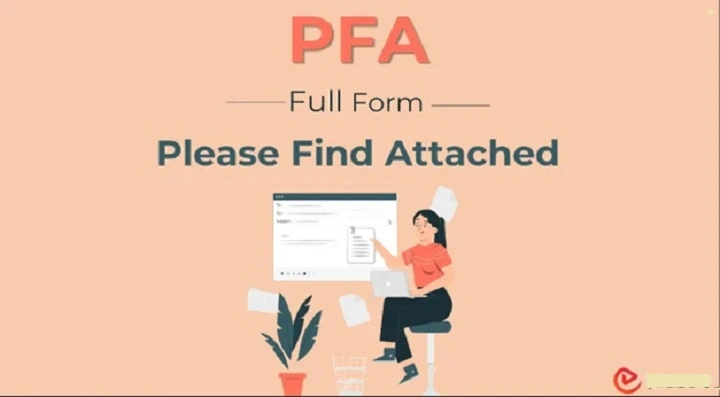
PFA inside an email stands for “Please Find Attached.” When sending along documents – say, a spreadsheet or image – you might see those letters appear. Often they show up without much thought at all. A tiny habit, really. Seems innocent enough.
Yet even a brief message like this holds patterns – ways of speaking, subtle tones, traces of office life. More than sharing a document, it hints at who takes charge, how ideas flow, what counts as clear enough. The way words land speaks volumes without shouting.
What PFA Actually Means
At its simplest, PFA tells the reader: there’s a file attached.
You’ll usually see it in lines like:
- “PFA the report”
- “PFA the invoice”
- “PFA the document for review”
It acts as a quick pointer. Nothing more on the surface.
But here’s the thing—modern email already shows attachments clearly. Icons appear. Files sit right below the message. So the phrase isn’t really needed anymore. It stays because people are used to it.
Why People Still Use PFA
PFA didn’t come out of nowhere. It made sense once.
Back in earlier email systems, attaching files was not smooth. People had to convert formats, shrink sizes, and double-check everything. Saying “PFA” confirmed the file was actually there.
Now, software handles all of that.
Still, the habit remains. Not because it’s necessary—but because it feels safe. Like a small signal that says, “I didn’t forget anything.”
The Hidden Role of PFA
There’s a subtle shift in responsibility when someone writes PFA.
When you say “PFA,” you’re stating clearly that the file is included. If something goes wrong—missing file, wrong version—the focus can shift to the receiver:
Did they miss it?
Did they check properly?
It’s not always intentional. But that small phrase quietly sets expectations.
Where You Place It Matters
PFA can appear in different parts of an email, and that changes how it feels.
Some people open with it:
“PFA the report.”
Others drop it in the middle:
“Please review the numbers. PFA the updated sheet.”
Or at the end:
“Let me know your thoughts. PFA.”
Each version carries a slightly different tone. Early placement feels direct. Middle placement blends into the message. Ending placement can feel like an afterthought.
There’s no strict rule. Context decides.
The Problem With Using PFA Today
Even though it’s common, PFA has a few drawbacks.
First, it’s vague. It doesn’t tell the reader what the file is or why it matters.
Second, it can feel outdated or robotic, especially in modern communication.
Third, it creates accessibility issues. Screen readers often spell it out as “P-F-A,” which slows understanding for some users.
So while it works, it’s not always the best choice.
Better Alternatives (Clear and Natural)
Instead of using PFA, you can say exactly what you mean.
For example:
“I’ve attached the Q2 budget summary.”
“The report is attached for your review.”
“You’ll find the invoice attached below.”
These versions do two things:
- they sound natural
- they explain the file clearly
You’re not just pointing—you’re guiding.
A Better Way to Write Attachment Emails
Instead of relying on shortcuts, build clarity into the sentence.
Start with the file itself. Then explain its purpose.
For example:
“I’ve attached the file Budget_Summary_Q2_2024.pdf. It includes all updated revenue and expense figures.”
This removes confusion. The reader knows what it is and why it matters.
When You Might Still See PFA
Even today, PFA shows up more in certain environments.
You’ll often find it in:
- legal emails
- finance or accounting messages
- formal office communication
These areas rely heavily on documentation and routine. So older habits stay longer.
In more creative or tech-driven spaces, people usually skip it and write more naturally.
Watch Out for Scams
There’s another side to this.
Because PFA is so common, scammers use it too.
Emails that say:
“PFA invoice”
“PFA urgent document”
can trick people into opening harmful files.
That’s why unexpected attachments should always be treated carefully—even if the message looks familiar.
Before You Send: A Quick Check
Before hitting send, pause for a second.
Ask yourself:
- Is the file actually attached?
- Did I name it clearly?
- Does the message explain what it is?
That quick check prevents most mistakes.
Bullet Summary
- PFA means “Please Find Attached”
- it points to attached files
- it’s no longer necessary in modern email
- it can feel vague or outdated
- clearer sentences work better
FAQs
What does PFA stand for in email ?
It stands for “Please Find Attached,” used to indicate a file is included.
Is PFA still used today ?
Yes, but less often. Many people prefer clearer, more natural phrases now.
Is PFA formal or informal ?
It’s considered formal, often used in business or professional emails.
Should I avoid using PFA ?
Not always, but it’s better to replace it with clearer wording.
What is the best alternative to PFA ?
Simple phrases like “I’ve attached the file” or “See the attached report” work better.
PFA sticks around not due to necessity, yet thanks to habit. It lingers less from demand, more from routine.
Old habits stick around, carried forward from early email days into today’s messages. Little by little, folks drift from it – no official ban, just quieter changes in their wording choices.
Most of the time, being clear works better than just cutting things short. What matters is hitting the exact point instead of going through the usual motions.
Exactly what you say can hit harder than any trio of taken symbols. Sometimes.
